Defining your Brand
What is a brand definition?
- what you are trying to achieve
- how you are going to get there
- why people should choose you over alternatives
Why is it important?
A strong brand definition sits at the heart of successful organisations.
It sets the direction for how your brand looks, speaks, and behaves. More importantly, it ensures consistency — so your brand doesn’t shift or dilute as your organisation grows.
When your brand isn’t clearly defined:
- messaging becomes inconsistent
- decisions take longer than they should
- marketing feels disconnected
- growth becomes reactive rather than intentional
When it is clearly defined:
- your team understands what you stand for
- your audiences understand why you matter
- your communications feel coherent
- and your organisation grows with purpose, not confusion
The strongest brands all start with clarity — regardless of size.
The strongest brands all start with clarity — regardless of size.
What does defining your brand involve?
Defining your brand isn’t a vague or creative exercise.
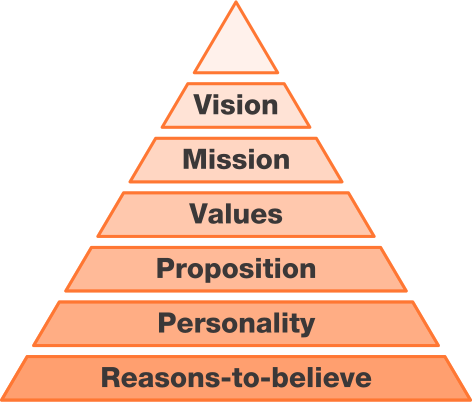
It’s a structured process that builds clarity layer by layer.
By working through this process, you create a brand definition that’s unique to your organisation — and usable in real situations, not just on paper.
Vision
Your reason for being.
The long-term change or future you exist to create.
Mission
What you are trying to achieve.
The role your organisation plays in moving towards that vision.
Values
What your organisation stands for.
The principles that guide behaviour, decisions, and culture.
Proposition
What you offer and why it matters.
The benefits that differentiate you from others.
Personality
How your brand expresses itself.
The tone, style, and character people experience when they interact with you.
Reasons-to-believe
The proof behind your brand.
The facts, truths, and evidence that support what you claim.
A practical framework for clarity
Together, these elements form a clear and usable framework for defining your brand.
Rather than trying to answer everything at once, the process builds understanding step by step – ensuring each part supports the next and nothing is left vague or assumed.
This structure removes uncertainty and replaces it with focus, direction, and confidence.
What a clear brand definition gives you
A well-defined brand captures what makes your organisation unique.
Used well, it helps you to:
- stand out in a crowded market
- communicate consistently and confidently
- make decisions more easily
- align your team around a shared direction
- and build stronger relationships with customers, supporters, or stakeholders
Ready to define your brand properly?
Understanding why brand definition matters is the first step.
The next step is having the right structure, questions, and guidance to do it properly – without jargon, confusion, or expensive consultants.